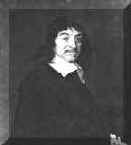
Rene
Descartes (1596-1650)
It has been said
that both modern philosophy and modern mathematics began with the work
of Rene Descartes. His analytic method of thinking focused attention on
the problem of how we know (epistemology), which has occupied
philosophers ever since. Descartes was educated at the renowned Jesuit
school of La Fleche where he was taught philosophy, science, and
mathematics. He earned a law degree and then volunteered for the
military in order to broaden his experience. When his duties allowed he
continued his studies in mathematics and science. Eventually he became
dissatisfied with the unsystematic methods utilized by the previous
authorities in science, since he concluded they had not "produced
anything which was not in dispute and consequently doubtful" (1, p. 6).
The only exception to this was in the field of mathematics which he
believed was built on a "solid foundation" (1, p.5). Medieval science,
on the other hand, was largely based on authorities from the past
rather than observations in the present, therefore Descartes decided to
conduct a personal plan of investigation. But, for Descartes, even his
personal observation of the "book of nature" (1, p. 7) was not
sufficiently beyond doubt because of his concern about the "deception
of the senses." After consideration of all the previous methods of
inquiry Descartes decided that there must be a better way; and in his Discourse
on Method he wrote, "I eventually reached the decision to study my
own self, and choose the right path" (1, p. 7).
Descartes aspired to rebuild a new system of truth based upon an
unquestionable first principle which, like the fulcrum of Archimedes,
would allow him to "move the earth from its orbit and place it in a new
orbit" (2, p. 23). The first principle that he finally felt was self
evident was summarized in the statement, "I think, therefore I am" (1).
Descartes believed that he could then use his new method of reasoning
to build on such a first principle, ultimately leading to the
unification of all knowledge. The method developed by Descartes was
based on the following rules (1, p. 12):
- The first rule
was never to accept anything as true unless I recognized it to be
evidently such: that is, carefully to avoid precipitation and
prejudgment, and to include nothing in my conclusions unless it
presented itself so clearly and distinctly to my mind that there was no
occasion to doubt it.
- The second was
to divide each of the difficulties which I encountered into as many
parts as possible, and as might be required for an easier solution.
- The third was to
think in an orderly fashion, beginning with the things which were
simplest and easiest to understand, and gradually and by degrees
reaching toward more complex knowledge, even treating as though ordered
materials which were not necessarily so.
- The last was
always to make enumerations so complete, and reviews so general, that I
would be certain that nothing was omitted.
In short, his method
required (1) accepting as "truth" only clear, distinct ideas that could
not be doubted, (2) breaking a problem down into parts, (3) deducing
one conclusion from another, and (4) conducting a systematic synthesis
of all things. Descartes based his entire philosophical approach to
science on this deductive method of reasoning.
Descartes was highly optimistic about his plan to reconstruct a new and
fully reliable body of knowledge. He even wondered if among "all things
knowable to men" there might not be a proper application of his method
so that "there cannot be any propositions so abstruse that we cannot
prove them, or so recondite that we can not discover them" (1, p. 13).
The apparently global scope of Descartes' speculations might lead some
to conclude that his epistemology demanded the rejection of all
authority, including the Bible. In point of fact, he considered himself
a good Catholic and with respect to the "truths of revelation" he
clearly stated, "I would not have dared to ... submit them to the
weakness of my reasonings" (1, p.5). Ultimately it was his religion
that kept him from living in a cocoon of personal introspection.
However, Descartes did plant the seeds for later dissent from the
theistic view of the world allowing for the humanistic dependence on
human reason alone. It was left to the humanists who followed to assert
an all encompassing rationalism that would take human reason as the
sole measure of what constitutes "truth."
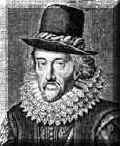
Francis
Bacon (1561-1626)
Francis Bacon has
been called the major prophet of the Scientific Revolution. At the age
of twelve Bacon went to study at Trinity College, Cambridge, later
acquired an education in law, and was eventually admitted to the bar.
He next embarked on a political career in the hope that it would allow
him to advance his emerging ideas for the advancement of science. In
due time he acquired a seat in the House of Commons, was knighted, held
the position of Lord Chancellor and Baron Verulam, and Viscount St.
Albans. He gained fame as a speaker in Parliament and as a lawyer in
some famous trials in which he was considered an expert on English
constitutional law. An outstanding thinker, Bacon was motivated to
write in areas as far-reaching as science and civil government in a
battle against the old order of scholasticism with its slavish
dependence on accepted authorities. He advocated the view that whatever
the "mind seizes and dwells upon with particular satisfaction is to be
held in suspicion" (3, p 477). His passion for the advancement of
natural philosophy was rooted in his belief that science was dependent
on and the key to technological progress. Much of his greatest
philosophical effort was applied to the Novum Organum in which
he described the inductive method of reasoning for the interpretation
of nature.
Bacon was very critical of those in the scholastic tradition who jumped
from a few particular observations to remote axioms, and then deduced
intermediate axioms through syllogistic demonstration. He also took a
dim view of those empiricists who had been side-tracked with
experiments done in depth without reference to related phenomena, since
they were unjustified in the breadth of their generalizations.
According to Bacon there were four categories of false knowledge, or
"idols," that had captured the minds of the men of his day. They are
paraphrased as follows (3, pp. 470, 471):
- Idols of the
tribe: False notions due to the human nature and common to all men.
An example would be geocentricity which was due to the limits of human
insight.
- Idols of the
cave: Personal interpretations due to individual makeup or
disposition. An example would be Gilbert's "magnetic world view."
- Idols of the
market-place: The problem of language and the confusion of words
and terms. An example of this relates to the problem with definitions
of words which likewise depend upon words.
- Idols of the
theatre: The dogmas of philosophies that are received from wrong
"laws of demonstration." This involves the results of the Aristotelian
method of syllogistic argumentation.
In contrast to
these, Bacon said that a true science progressed "in a just scale of
ascent, and by successive steps not interrupted or broken, we rise from
particulars to lesser axioms; and then to middle axioms, one above the
other; and last of all to the most general" (3, p. 519). In short, his
method required (1) accumulating a store of particular empirical
observations, (2) from these inductively inferring lesser axioms, (3)
from these inductively inferring middle axioms, (3) and then proposing
the most general of notions, each in progressive steps. If we read
modern meaning into the language used by Bacon, we might see a
foreshadowing of the idea of a hypothesis in a "lesser axiom" and a
theory in the "middle axiom." This would make his method agree with the
mature conception of science in use today; however, the context
indicates that his ideas were not yet so fully developed. Bacon also
argued that this inductive method "must be used not only to discover
axioms, but also notions," which may be taken to correspond to the
concept of a paradigm, but again this may be reading into the text. In
any case, it is clear that Bacon's view of the scientific method is
progressive and cumulative.
The radical commitment to empiricism advocated by Bacon may imply for
some that he did not accept any knowledge that was not received by
personal observation. This is a mistakenly narrow interpretation of
Bacon's view of natural philosophy which he believed was given as the
"most faithful handmaid" of religion (3, p. 509). Bacon actually saw
his new way of acquiring knowledge as a fulfillment of Biblical
prophecy concerning the last days: "Many shall go to and fro, and
knowledge shall be increased" (Dan 12:4). Further, he saw the
technological advancement of science as a restoration of the "dominion
mandate" (Gen 1:28), and thus he wrote, "man by the fall fell at the
same time from his state of innocency and from his dominion over
creation. Both of these losses however can even in this life be in some
parts repaired; the former by religion and faith, the latter by the
arts and sciences" (4, p. 267). There was, however, reason to believe
that Bacon's views would play into the hands of humanistic concerns,
since he also believed that his inductive method would "extend more
widely the limits, of the power and greatness of man," and one day
"embrace everything" (3, pp. 527, 536). For those who later advocated a
"scientific world view," this prediction was claimed to be fulfilled.
Comparison
and Contrast of the Methods of Descartes and Bacon
The differences between the methods of Descartes
and Bacon are many and deep, but there are also many things they have
in common. Each of these pioneers advocated the complete overthrow of
all the methods and most of the results of the authorities that came
before them. Both of these men demanded a new standard of precision,
since there were so many examples of sloppy reasoning and observation
that littered the path of the science of the past. There was also a
common commitment to doubt in general and a concern about the
"deceptions of the senses" (3, p. 474). In addition, they believed in
the reduction of problems to their smallest constituent parts as a
general principle. Descartes and Bacon each saw himself primarily in
the role of an advocate for science and therefore they contributed very
little to any particular field of empirical science (5). Finally, both
of these men were uniquely gifted to promote the particular aspects of
science that were eventually crucial to its advance.
The most obvious difference in methodology between Descartes and Bacon
was related to their procedures for reasoning. Descartes began with
intuitively derived principles that were taken as the premises in the
standard deductive method of reasoning, but Bacon began with empirical
observations that were used to inductively educe higher axioms.
Descartes' method was a "top down" approach, whereas Bacon's was
"bottom up." So strong is this particular contrast that it seems at
times that Bacon was writing specifically about Descartes' method as an
example of what was wrong in science. A crucial difference in the
background of the two men is seen in the mathematical mastery of
Descartes as compared to the mathematical neglect of Bacon. Descartes
is noted for his great accomplishments in the areas of algebra and
geometry, whereas Bacon's spoke little of mathematics since his area of
expertise was law. Background may explain the similarities in the
method of Descartes which parallels that of mathematical proofs. For
Bacon the empirical observations he emphasized for science may parallel
the kind of "eye witness" evidence he required when building a case in
a court of law. In view of Descartes background it appears obvious that
his exemplar would be found among the mathematicians who he said "alone
have been able to find some demonstrations, some certain and evident
reasons." Therefore, he decided to "begin where they did" (1, p. 13).
In spite of Bacon's distinguished background he was actually very
pragmatic in his pursuit of an exemplar which he found among the
"mechanics." It was the "mechanical arts which were founded on nature
and the light of experience" (3, p. 493). Because of this observation
he was greatly impressed with the discovery of printing, gunpowder, and
the magnet. In his view "no empire, no sect, no star seems to have
exerted greater power and influence in human affairs than these
mechanical discoveries" (3, pp. 538, 539). It is important to note that
as different as the methods of Descartes and Bacon were, when the their
exemplars are synthesized into one, we have an anticipation of the
modern mathematical-experimentalist. We can now see that when taken
together, Rene Descartes and Francis Bacon were germinal for the modern
scientific method.
Footnotes:
1.
Rene Descartes, Discourse on Method, Trans. L. J. Lafleur.
(Bobbs-Merrill, 1950).
2. Rene Decartes, Meditations, Trans. L.
J. Lafleur. (Bobbs-Merrill, 1960).
3. Hugh G. Dick (ed.), Selected Writings of
Francis Bacon. (New York: Modern Library, 1955)
4. Fulton H. Anderson (ed.), The New
Organon. (New York: Macmillan Publishing, 1960)
5. Descartes did, however, contribute greatly
to mathematics which is the proper place of application for his
deductive method.
Tim
Nordgren, 5-17-98
Home
|